

All posts by Dr. Charlie Self

The Path Forward, Part One: Seeking and Telling the Truth

“Everything is political.” “Knowledge is merely a power struggle.” ‘My job as a journalist is to tell my truth.” “Objectivity and seeing things from both sides are overrated notions.” “Hate speech is anything we hate.” These are just a few of the observations of that reveal our current crisis of knowledge and further deepen cultural and political divisions across the globe and in the USA.

In our data-saturated and wisdom-deficient age, the very notion of objective truth is questioned, with particular “narratives” gaining prominence over exploration of evidence, critical thinking, and continual modification of understanding. Humility demands that we are tentative about final conclusions of many matters, but this does not mean utter agnosticism or an absence of relative certainty.

Along with profound public contention, this subjective view of truth leads to devastating personal and social consequences. First, we are paralyzed by self-deception and unable to tell the truth to ourselves, lest our carefully-crafted, protective “safe space” be shattered by the laser-light of reality. We adopt (even unconsciously) feigned humility and smug confidence utterly unjustified by any empirical facts or rational reflection. “My opinion is just as good as yours!” is the petulant cry of infantile thinking, not an invitation to debate as maturing adults.

A second consequence of this subjectivity and solipsistic mindset is that we no longer voice our ideas to each other, with a view toward civil debate and growing in wisdom. We are quick to cancel, slow to listen, and hastily place people in categories that allow us to avoid hearing their thoughts. We assume way too much, instead of looking for common ground, nuance, and potential refinement of our own ideas. For example, in the (often simplistic) debates between capitalism and socialism, caricatures abound and reality is tossed out the window. Most thoughtful women and men do not want a return to Maoism or Stalinism (though it is surprising how many will exchange freedom for security!). Free-market thinkers do understand that personal and social ethics are at the heart of the confidence and trust needed for free exchange and opportunity. The Scandinavian nations are capitalistic with a large safety net (and rather small, homogenous populations), and have been cutting back on the size of government for a decade or more. We need economic debates – without the labeling and libeling.

A third consequence is building public policy on insufficient information. Partisan loyalty is prized over careful stewardship of public resources, and immediate power gains take priority over long-term fiscal and social consequences. For example, better stewardship of the environment is the right direction, but the apocalyptic rhetoric is leading to policies devasting to the working classes and enriching to high-tech firms that will parrot the party line. The progress of the last several decades and the resistance of non-Western empires to any change is ignored in favor of “climate catastrophe.” Anyone not emotionally engaged in this crisis is deemed a “denier” – placing their views parallel to Holocaust denial! Research? It only matters if it furthers the narrative of massive wealth transfer. Criticism? You are destroying the earth. We can do better than this.

Looking forward, there are three positive dispositions and disciplines that are helpful. First, we can choose humility, courage, and love as our foundations for fruitful learning and discourse. If our motives are right, our minds are open, and we desire for all others the opportunities and wisdom we enjoy, the world is a better place. Second, we must – with kindness and patience – refuse all attempts at intimidation and state our convictions and ideas and allow them to germinate, be refined, and be either discarded or improved. Finally, we can consciously and consistently dialogue with women and men who see the world quite differently. Minds may not immediately change, but friendships can form, arenas of cooperation be discovered, and exemplary civil discourse can help set the tone for coming generations.

Let’s tell the truth to ourselves and others.
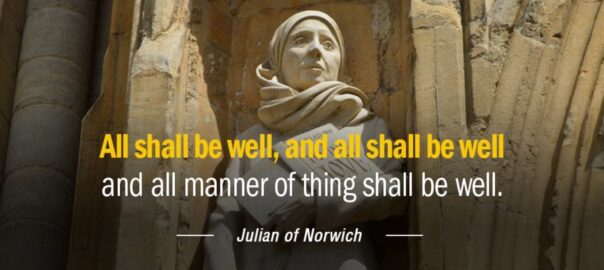
All Shall Be Well

Juliana of Norwich was a 14th century anchorite and spiritual writer and the first female author published in English. She was not formally a nun, but lived most of her life in a small room, receiving daily food through a window and dedicating herself to prayer. Her best-known book is Revelations of Divine Love. Her infatuation with God and desire for others to know divine love and grace influenced thousands in her day and millions of readers over the past centuries. She shared her hope and love in a world full of plagues and wars (that make COVID-19 seem tame), ecclesial disputes, and social unrest. Why was she so happy?

Juliana experienced deep intimacy with Christ, both as the Crucified Savior and Risen Lord. She knew the entire biblical narrative and the final chapters of the Book of Revelation spoke to her as she reminded her suffering friends, “All shall be well, and all manner of things shall be well.” The hope of the resurrection and the beautiful visions of eternity detailed in Scripture informed her optimism in the midst of so much degradation and tragedy.

We need Mother Juliana’s hope in our world. Easter reminds us that death does not have the final word and our current afflictions are working new affections of compassion and endurance in our souls. Injustice and underserved pain, the selfishness of the powerful, and our own self-inflicted wounds all conspire toward fatalism and hopelessness. But Easter has come and our mourning turns to joy as our tears are dried by the nail-scarred hands of Christ!

It was the Holy Spirit that gave Juliana of Norwich her revelations of divine love and hope. The same Holy Spirit lives in every believer and in the church opening our hearts and minds toward courage and wisdom, and loving service. The same Holy Spirit will empower the sharing of the Gospel as we invite others to experience forgiveness, healing, and foretastes of eternal delight.

While we contend for truth, work for justice, and engage in all domains of our culture, we will have defeats and victories, tragic reversals and miraculous advances. In the midst of it all, our Risen Lord reminds us, “All shall be well.”

Our Stories Are Not Finished Yet

The Lenten Season is a period of self-reflection and sacrifice as followers of Christ ponder the obedience of Jesus that led to a Cross and Resurrection, bringing hope and reconciling grace to our weary world. The story of Jesus includes his humble beginnings. It features family life in an artisan’s home. There is a Bar Mitzvah that astounded some learned religious leaders. And then there were quiet years running a business until his early 30s. If the narrative stopped here, it would have been one more story of an anonymous Jewish family in the early first century.

But the full story continues as Jesus begins his public ministry. For more than three years this Rabbi delivers and heals, forgives and reconciles, teaches and demonstrates the love, grace, and truth of God’s kingdom. For his trouble, Jesus is betrayed, arrested, subject to multiple (mis)trials, scourged, crucified, and buried in a borrowed tomb with a 24-hour Roman guard. If the story had ended here, Jesus would have been one more zealous Rabbi and wonder-worker and perhaps classified as a good teacher by some and a pernicious influence by others. (Oh wait…isn’t that how many still see him?)

But the story is only complete on Easter morning as the Lord is raised from the dead in a transformed body still bearing the scars of his atoning death while revealing the ultimate future of all who believe. Easter is not only a promise of eternity, it is a present reality as followers of Jesus receive the Holy Spirit and walk in his pathway of love and humility, offering the same deliverance and healing, forgiveness and reconciliation to all.

And Easter means that all of OUR stories are still being written. Starting right now, our future can be different as we listen more deeply to our Lord, align our hearts and minds with his commands, and join Jesus in his mission. Yes, we may bear the consequences and scars of previous traumas or our own sins. No, we cannot be “anything” we imagine – that is nonsense. But starting today, we can become the best version of the person God created us to be and start doing the good works he designed in advance for us to do. We were created to enjoy God’s presence and fulfill his purpose. As we worship and work, and allow the Lord to refine our character and define our charisms, a better future opens to us – and to the world.

Our stories are not finished until our mortal journeys have ended. And even then, they continue in a new creation. Be encouraged today! Jettison the fatalism and the fantasies, and embrace the Cross. In humility and service, we discover our purpose and find great strength.

Out of Disappointment Comes Determination

People of conscience and thoughtfulness in both political parties are at a crossroads. The events of January 6th and the recent policies of the new administration are troubling many. The legacy of the previous administration was deeply tarnished and the promises of unity and amicable dialogue of the new folks in Washington are remain unfulfilled. Power and punishment, rancor and reaction dominate the public square and there is utter disregard for any fiscal restraint.

Out of the deep disappointment of this moment is an opportunity for a new determination for people that care about the common good and want all Americans engaged in helping their neighbors flourish. Beginning the week of April 5, I will introduce a nine-part series, “The Way Forward.” I will outline pathways of progress on the most challenging issues of our time. Until then, the focus of this essay and the two that will follow will be on the changes in us that provide the soil from which creativity and innovation thrive.

Here are seven “decide ahead of time” choices that help us face the world with confidence and humility, hope and courage.

  • First, we stop lying to ourselves. We must own the areas of self-deceit that capture our hearts and minds. 
  • Second, with our new found humility, we now own our personal choices and get the help we need so that any lingering victim-hood recedes and is replaced by empowerment.
  • Third, while we engage in the political process, we realize that we do not elect messiahs. Some emotional/mental distance from political soundbites will improve our health.
  • Fourth, we choose pathways that help us befriend people very different from ourselves and learn from their sufferings and triumphs.
  • Fifth, we own our historical narratives – all of them. We reject nostalgia and cynicism and recognize the good and the evil in human hearts and social systems.
  • Sixth, we do not wait for government programs to help others in need. Our churches, daily work, local charities, and many other venues offer ways of concretely changing lives.
  • Seventh and supremely, we must return to God in awe and reverence and stop making ourselves the center of the universe. When we follow the way of Christ – a life of service that will include suffering infused with love and hope – we find all our best and deepest longings fulfilled.

Will we spend less time scrolling and more time praying? Will we stop reacting with clenched fists and begin responding with open hands? It all begins with each of us and the choices we make each day.

“Science is Real” Separating Facts from Ideology

As Kathy and I walk our neighborhood, we occasionally see signs that include a variety of slogans, including, “Science is Real.” This phrase is part of a campaign by climate activists to demonize any “deniers” that question human-caused climate change and support radical proposals to “save the planet because we have only 9, 12, 20, or 50 years left.”

Science is a wonderful part of humankind’s creativity and curiosity. It yields amazing breakthroughs for human flourishing, from healthy foods to medical care, technology for the workplace, and so much more. The founder of the modern state of Singapore was asked about the most important invention of the 20th century. His response? “Air conditioning.” Without it, computers cannot function and billions living in tropical climates cannot be productive. Science is an ever-evolving series of experiments and findings, discussions and discoveries, and the source of much debate! For people of faith, science is a gift from God, part of common grace or natural revelation. Science is not a deity, but the amalgamation of human inquiry. It can be used for good or manipulated for evil.

Human-influenced climate change is tracked using a combination of historical temperature readings, computer modeling, and current observations. Leaving aside exaggerated terms like, “97% all agree that…” or “there is no problem” – how do we sort our facts from ideology? And, just as important, how should consensual science inform economic and social policies affecting billions of people?

Let’s assume that “the science is real” and humankind is having a deleterious impact on the climate. Current solutions emanating from the UN and the West are radical and have little actual impact on global temperatures. Adding to this reality is the fact that we have seen a shift in language from “global warming” to “climate change” because the trends are not conforming to early computer models. Science is being used as a cover to destroy the fossil fuel, natural gas, and nuclear power industries, with inadequate replacements.

The way forward is neither denial nor apocalyptic measures. Good ecological stewardship is good economics. Science is already reducing emissions enormously in the developed world. Alternative energy solutions are emerging, but are not yet cost-effective as complete replacements. And here is the key: Global elites and politicians love greater control over people’s lives and arranging massive transfers of wealth – none of which affect them (unless they benefit)! The losers are middle- and working-class folks around the world that need affordable energy. We can improve the environment and ensure all can flourish without impoverishing billions for the wallets and power grabbing of a few. We need a concomitant strategy of improving the emissions of current sources while developing low-cost alternatives. As the science catches up to our dreams, we can see a better world without chaos and the loss of liberty.