
All posts by Dr. Charlie Self

We Know Better, Part 10: Sex Education and Gender Ideology

In such volatile times, prudence is a special virtue. The moment the words gender and sex are used, accusations start flying and anger overtakes reason. In this essay, I am going to share some principles for a new civil consensus on sex and gender issues, especially in public education and public square debates.

I am NOT advocating any kind of coercive ideological or religious conformity – just the opposite.  I am searching for principled compromise that will lower the temperature, restore toleration (as a virtue of living with our differences, not being forced to affirm ideas we reject), and offer a way forward for the common good. I think liberals and conservatives dedicated to the highest ideals of freedom of conscience can find some level of agreement. Radical activists will never be satisfied with anything other than cowing their opponents and compelling eternal penance from any who differ.

Principle One: We must acknowledge that we live in a pluralistic society and that freedom of conscience is a first freedom that establishes all others. Political and social majorities do not have the right to impose their beliefs on minorities. We can celebrate cultural, ethnic, and religious diversity, and the free market of ideas.

Principle Two: We want all people to being their highest selves to work and public service; therefore, we are not demanding that religious convictions be checked at the door. We are expecting maturity that affirms Principle One and works for principled consensus.

Principle Three: The family is the primary educator and purveyor of values and worldviews. The state does not have the right to compel belief or speech contrary to conscience. Expressing deeply held moral convictions is not hate speech or violence, provided our citizens learn to share them with respect. For example, my belief that sexual intimacy is reserved for lifelong, heterosexual, monogamous marriage is not intolerance, for I share these ideas with neighbors who see the universe differently and they have the same right to share their convictions.

Principle Four: Sex education in public schools should focus on biological changes and reproduction, leaving gender ideology to the family. There is no place for schools to secretly oppose family values or impose their ideas in or out of the classroom.

Principe Five: People with body dysphoria deserve love and compassion and good counsel. Any medical procedures, from drugs to surgery, should be reserved for adults and paid for by the persons seeking the changes. If a 10-year-old boy wants to be a girl, he/she can seek out specific treatments once they are 18 or 21, just like other adult activities. In most cases, experimentation with gender and identity finds its natural place eventually (as the brain matures in the early 20s), so serious interventions are premature, unproven, and even dangerous to long-term well-being.

Principle Six: We must restore toleration to its original meaning of living peaceably with our deepest differences. Toleration is not compelled agreement. No business or artist should be compelled to promote ideas that violate their conscience. It is interesting noting that activists never target Jewish, Muslim, Hindu, or Buddhist bakeries or businesses, only ones owned by Christians.

Principle Seven: The mostly binary nature of humankind and the animal kingdom is a scientific fact. Exceptions exist, but we have allowed exceptions to become the rule and distort obvious statements of fact. A woman is an adult biological female. She may be attracted to the opposite or same sex, but she is a female. A man is an adult biological male. The DNA and biology do not lie. This said, we are not demanding that adults who have crafted a particular identity be prohibited form living peaceably in our world. Those who disagree with these choices are not evil.

Principle Eight: Human beings are complicated and there should never be bullying, intimidation, or any kind of intolerance or violence toward people who see the world differently. This does not mean I celebrate ideas I differ with. This does mean that we must not reduce maleness and femaleness to time-bound idols, personality and interest types, or particular subcultural characteristics. We must desire that all people flourish and bring their gifts to our world.

It is impossible to address these issues without provoking reactions. Good! Reactions mean we care. The question is, will we move from reaction to true toleration? I live among neighbors who see the world very differently. I have family members with diverse worldviews. We argue, debate, and then have dinner. May we find the courage and compassion to do the same.


We Know Better, Part 9: Economics 101: A Call for sanity

If we managed our family checkbook like the federal government, we would all be bankrupt. It is one thing having deficit spending in wartime or particular crises. It is quite another to simply print money, sell T-Bills and leave $30T for future generations to manage. It is immoral, unconscionable, and terrible economics. We have tried to be a warfare and welfare states since the 1960s and we must alter course.

In this essay, I am not ranting about the current administration’s out-of-control spending and highly political largesse for voters. Anyone can do that. I am not going to lambaste both parties for their refusal to trim waste and remember that all the money they spend in Washington, D.C. originates with taxpayers. I am going to offer a way forward that is at first glance naïve and simplistic, but upon further reflection, incorporates the insights of leading thinkers of the last half-century and is non-partisan and non-ideological.

I think we must argue about spending priorities, just like the family dinner table, a small business, or the corporate boardroom. I think we must argue about a fair tax system, from flat taxes, modified flat taxes, progressive tax rates, and levels of corporate taxation. Let the debates begin in the House of Representatives where they belong, and let Congress do its job.

We also forget that decentralized administration is almost always more efficient and fairer, so it should be a long-term priority to have our states, counties, and cities receive a larger portion of our tax dollars and Washington, D.C. much less.

OK, here are three simple points that will transform our economic future, without starving anyone or leaving America defenseless.

ONE: We must achieve a truly balanced budget ASAP, preferably in the next five years, beginning with significant deficit reductions and then living within our means. What does this mean? Here are some ways forward under this heading:

  • Reduce ALL federal spending by 15-20% across the board, targeting inefficiencies, encouraging retirements, rewarding departments under budget, and placing moratoriums on discretionary spending. (Oh, and place all elected and appointed officials back in the social security system and privatize their pensions.)
  • Look to eliminate unneeded agencies, restore as many functions as possible back to state and local governments, and welcome input from business leaders on more effective administration.
  • Decide ahead of time that we must live within our means. Need more money for a particular program that is working? Then find new revenues that are not hurting the productive and perhaps cut other budgets if needed. 

TWO: We must transform our overly-complex federal tax system. We have higher corporate tax rates that many “semi-socialist” nations in Europe. The top 10% pay more than 60% of the taxes and almost half of all American pay little or nothing. Here is a pathway forward:

  • Move to a modified flat tax that is revenue neutral from the baseline of a selected year, like 2019 (when the economy was good). Start at 5% and set the cap at 20%. Do the math. There is enough money.
  • Over a five-year period, eliminate all personal deductions – yes, ALL deductions, including charity, mortgage interest, etc. If I know I will never pay more than 20%, then I am still incentivized to earn more. If I know that at least 5% will be paid, I will aim to work hard and advance.
  • Corporate tax rates must be fair and reasonable and we must stop the cronyism that exempts some elites and places the burdens on the rest of corporate America. Tax only profits after accounting for expenses, R&D, etc., and do not tax dividend, stock, and other capital gains above the lower rate. I recommend 20% as a maximum rate.

THREE: This is the hardest of all: We must stop looking to the federal government to directly solve problems best tackled by more local private-public partnerships. WE DO need the universal ethics of the federal government, but not the ubiquitous administration. For example, an FDA is good, but a government-run meat company would be terrible. Here are some first steps:

  • End all loans for education. Encourage grants and scholarships from states and private sources. Continue with scholarships for veterans and particular fields that serve the common good.
  • Streamline military and welfare agencies so that the cost of services is reduced and the frontlines are actually helped instead of everything being entangled in a bureaucratic mess.
  • NO taxes on personal inheritances. It is immoral to tax again monies already taxed.

The burden for these changes is on us, the American citizens that vote. Will we see the moral problem of spending or capitulate to fatalism and hope we get our share? Our grandchildren need our courage! And if we make these changes, our economy will again be the envy of the world.

We Know Better, Part 8: More wisdom from Life in 5-D

Last week we shared a vision of wholeness in Christ and hope you are encouraged to pursue God more deeply and buy our forthcoming book! In this essay, I want to offer some biblical foundations and practical wisdom so that we can jump-start progress in both our personal relationship with the Lord and in our local churches being more effective in equipping healthy believers. Here is an excerpt from the Introduction of our forthcoming book, Life in 5-D:

Our starting point was a simple question: “What does a healthy disciple look like?” Another way of saying this is, “What are the outcomes of a Christ-centered life under the kingdom of God?” One leader was blunt, “What does life look like when Christ is Lord of all?”

The Bible itself contains several summaries of what God expects of His followers. In the Old Testament, The Ten Commandments (Exod 20 and Deut 5) are imperatives for the people of God, outlining a life of gratitude rooted in God’s election, deliverance, and covenant-love (Exodus 4-20). Micah 6:8, in poetic fashion, summarizes a whole-life commitment of justice, mercy, and devotion.

Jesus shared the foundational attributes of Kingdom life in the Beatitudes (Matt 5) and His blessings (Luke 6) from the sermons on the mount and plain. Jesus told His followers that the commands to love God with one’s whole being and love one’s neighbor as oneself are the foundation and fruit of all of God’s ways (Matt 22:37-40).

Paul the Apostle, in the great love chapter of 1 Cor 13, unveils attitudes and actions that are the fruit of a life devoted to Christ. The fruit of the Spirit and the virtues of divine life are outlined in Gal 5:22-23. Peter offers another list of beautiful virtues in 2 Pet 1:1-10.

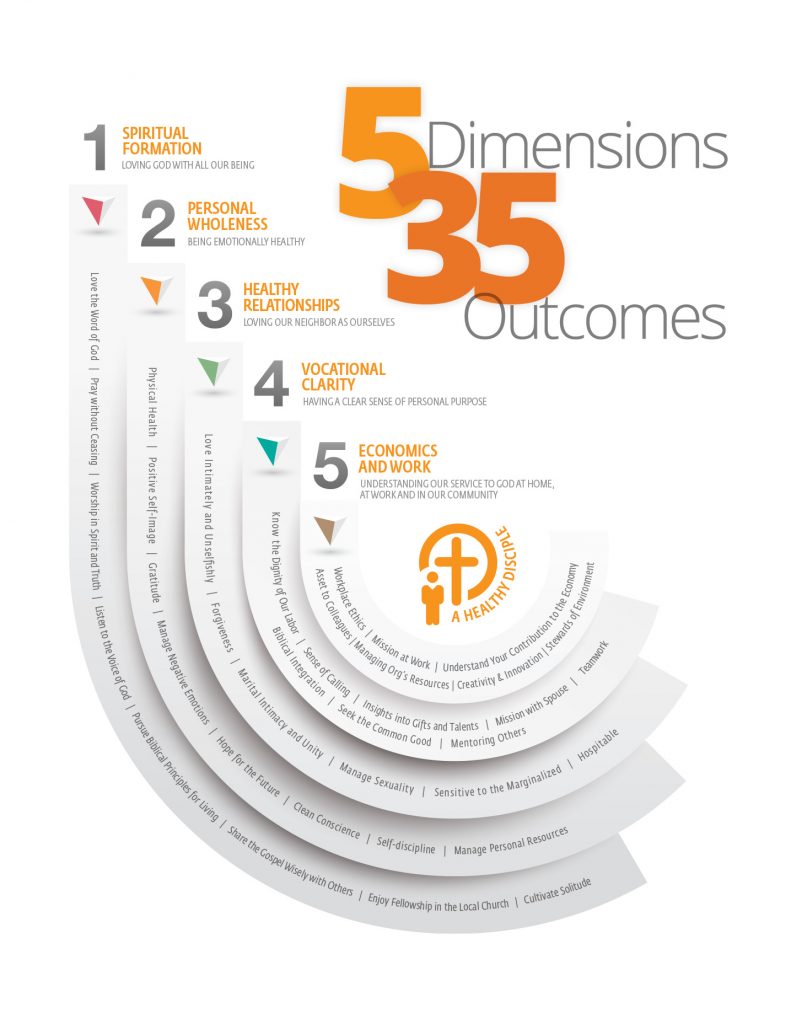
In the Book, we summarize the application of these beautiful passages in 5 Dimensions and 35 Outcomes.  In visual form, here is a new picture of wholeness:

“Wow! That is so much to grasp!” yes – and we have an adventurous lifetime with the Lord to understand and grow in this wholeness.

If we are serious about a flourishing life, here is another passage from the book to encourage us forward:

Here are three insights that will help us be victors and not victims as we move forward:

One: Our life will include both joy and suffering, unexplainable difficulties, and unbelievable delights. We are always walking in both, “the power of his [Christ’s] resurrection and participation in his sufferings” (Phil 3:10). When we embrace this paradoxical power of Christ, we will find greater endurance and discover fresh wisdom as we reflect on how God is at work for our good in all circumstances (Rom 8:15-39). For those of us who love theology, this is an integration of a theology of the Cross and a theology of glory.

Two: Satan has no weapon against humility. This is why both James and Peter exhort believers to humble themselves and then see the enemy flee as they resist his temptations (Jas 4; 1 Pet 5). When we aim for God’s glory and the good of others, eschew power-seeking for service, and celebrate others more than ourselves, we are filled with peace, trusted with divine power, and fulfilling God’s will in all we do (Mark 10:45).

Three: Expect an inner battle in addition to circumstantial challenges. As we embrace the 5 Dimensions and 35 Outcomes of our life in Christ, all kinds of distractions, distortions, and even depressing thoughts will fill our minds: “Nothing ever changes.” “These ideas are fine for some people, but not for me.” “This is too complex.” “I am not important.” In addition to these thoughts, we must also guard against spiritual pride as we embark on this journey.

With hearts full of faith, Let’s decide that today’s discipline is tomorrow’s destiny and that with God’s help, we can see real progress!

We Know Better, Part 7: Helping People Become Whole

Wisdom from our forthcoming book:

Life in 5-D: A New Vision of Discipleship

Dr. Charlie Self
with Dr. Johan Mostert, and Jamie Bolds, Ph.D. (c)
Foreword by Tom Nelson
Afterword by Scott A. Hagan

This fall, hopefully in October, our new Book, Life in 5-D will be available. We are excited to present the fruit of more than a decade of field research, listening to hundreds of leaders and learning from thousands of thoughtful people. We asked a simple and complex question, “What does a healthy follower of Jesus look like?” What are the OUTCOMES of a life devoted to Christ?

The revolution behind this question is seeing Christian formation as more than duties and programs. Discipline and organization are helpful, but they are the means to the biblical end: the very life of Jesus Christ being experienced and expressed through each follower of Jesus.

The Bible is clear about love for God and love for neighbor as the foundation of pleasing God and becoming more like Christ. But what do these twin commands look like in everyday life and who can we know we are making progress? The Great Commission that animates Church missionary activity is rooted in, “making disciples of all nations.” Since the mission is making disciples and making disciples in the mission, a picture of wholeness that in rooted in Scripture and empirically measurable will help us.

Over the past decade the authors have learned from many. The result is the first and only comprehensive assessment of wholeness that is both biblical and scientifically validated: the Discipleship Dynamics Assessment (DDA)™. You can find this amazing vision and tool here: www.discipleshipdynamics.com. It gives the person an accurate snapshot of how she is doing in 5 Dimensions and 35 Outcomes. If a leader creates a group (from a small group to a whole congregation), he receives a Dashboard on the group as a whole, while the individual results remain confidential. We hope you will enjoy this resource!

Our new book has been in formation since 2011 and we are excited to offer insights on these dimensions and outcomes, along with testimonies and practical helps for growth. Here are some of the endorsements we have received:

“Western Christianity is facing a crisis of authentic benchmarks. Our spiritual compass is spinning like fan blades as true north is constantly being redefined by new trends and temporary movements. Life in 5-D is an invitation to stop the madness and do a hard reset of Biblical standards that restore life, health, and balance.” (Gene Roncone, Superintendent, Rocky Mountain Ministry Network of the Assemblies of God)

Life in 5-D is a look at discipleship with a special focus on where we spend most of our productive week, what we do Monday through Friday. This integration of faith and work is often missing in our reflection about our walk and faith. So, this book not only causes us to reflect on what goes into discipleship but what that looks like in settings we usually do not think about when thinking about our spiritual growth and maturity before God. (Darrell Bock, Executive Director of Cultural Engagement at The Hendricks Center and Senior Research Professor of New Testament studies at Dallas Theological Seminary in Dallas, Texas)

“What does it mean to be a disciple of Jesus? At one level, the answer is simple–learning to obey everything that Jesus commanded and modeled, in reliance on the Holy Spirit. And yet, we have a sense that we have lost our way, with too much attention on programs, and not enough attention on pursuing outcomes that align with the way of Jesus. Life in 5-D offers a much-needed correction, calling us back to a clear vision of the goal–being transformed into the likeness of Christ in every dimension of our lives.” (Matt Rusten, Executive Director, Made to Flourish)

We covet your prayers as we go to publication. As we were creating the assessment and book, a Children’s Pastor of a local church the Dimensions and said that he could teach them to 8-year-olds and 88-year-olds! Inspired by his hopefulness, here are five questions that bring together wholeness in Christ. We hope you are inspired to use this way of thinking as you go forward in life:

  • How am I doing in my walk with God? Am I enjoying God and experiencing both comfort and conviction? (Spiritual formation)
  • Am I overcoming my painful history and growing in hope? Am I allowing the Lord to help me manage my emotion and enjoy a clean conscience? (Personal wholeness)
  • Are all my relationships becoming healthy? From marriage to ministry, personal and professional, am I learning to love others wisely? (Healthy relationships)
  • Do I have a clear sense of calling or purpose that is more than my current job? Am I offering my gifts in service to God and the world? (Vocational clarity)
  • Do I see the importance of economic wisdom and my daily work? (One child said, “I am doing my chores for Jesus!” – we like this!) Do I know that all my tasks are holy? (Economics and work)

I (Charlie) hope will be inspired to use these questions in your daily life of prayer and thoughtfulness. Let’s become part of a coming awakening that transforms individuals and communities, neighborhoods and nations.

We Know Better, Part 6: Israel as a Gift to the World

This year, on May 14, the Nation of Israel celebrated her 74th birthday. In the shadow of the Shoah, and against all military and political odds, this small country has survived multiple invasions, continual terrorist attacks, and generations of global leaders seeking her destruction or delegitimization. Although the United Nations approved Israel’s creation in 1947, she has uniformly persecuted this democracy since the 1950s. For a century (from the 1920s to the present) key State Department leaders in the USA have been anti-Semitic and opposed any policies supporting Israel. During WWII, such sentiments kept millions of Jews from emigrating to the USA and other Western nations.

Today’s university students in the USA and Europe are subject to a barrage of agitation propaganda that accused Israel of “apartheid” policies, “war crimes” and being a European or White, “settler-colony” displacing native Palestinians. Some even question significant historic Jewish presence in the region. The BDS campaigns to cripple Israel economically and the well-funded Arab/Middle East Study centers on hundreds of universities means that most students are getting a very one-sided narrative.

Islamist and other radical politicians are proposing that the US congress declare the creation of Israel a “disaster” or “tragedy” and they encourage eliminating any aid to Israel until she relinquishes all the “occupied territories” from her 1967 Six-Day War victories. 

Let’s set the facts straight and get a balanced view of historical and contemporary reality.

The Jewish people have a continual presence in the Holy Land for over 3000 years. This is verified not only in the Bible, but by numerous archeological finds.

“Palestinian” is a created national identity in the wake of pan-Arab failure to destroy Israel in the 1950s and 1960s. Arabs displaced by the war suddenly have an identity as refugees and victims, with no Arab states welcoming them as citizens. I am not minimizing their suffering, but with all the wealth available from Arab states, there should be no one in poverty.

Israel has agreed to numerous plans (1949, 1956, 1967, 1976, 1999-2000, 2010, 2015) for peace and offered 92-96% of the territory gained in 1967 in exchange for recognition, diplomatic exchange, and an end to state-sponsored terrorism. Israel is not the aggressor and her measured responses to continual terrorist attacks are models of restraint.

Israel has more than two million Arab citizens integrated into all facets of society. Contrast this with current Palestinian leaders calling for a “Jew-free” (echoes of the Shoah in Germany) state next door.

Israel is the only democracy in the region, with freedom of conscience and religion, and numerous political parties and social activists. The joke in Israel is, “Five Israelis, six political parties.” The only place in the entire Middle East where LGBTQ+ people have any liberties is in Israel.

Israel is dubbed, “start-up nation” and leads the world in many areas of agriculture, water reclamation, energy technology, medical advances, and information sciences. In fact, Israel’s sworn enemies quietly go to Jewish doctors for critical medical procedures, and Israel is exporting oil and natural gas to her neighbors.

Israel is not perfect and her own citizens are the most critical. There are Left and Right parties, and much discontent. She is working on economic and security alliances with her neighbors and remains open to peacemaking, if Arab leaders and Western elites will face the realities that she is here to stay and a good partner for freedom.

Israel is a gift to our world and we should celebrate her surviving and thriving under such adverse pressures.